Providing customers with the highest quality of water is a top priority. To accomplish this, the District employs State-certified water treatment operators who continuously monitor and test our water. Water samples are collected and analyzed daily from various locations around the District. Both District staff or by independent State-certified laboratories conduct this testing.
The latest Water Quality Report was released in April 2026. Learn more about this annual report below.
Potable water is sourced from wells that vary from 350 feet to 1,750 feet deep. Groundwater is pumped from the ground and filtered through a pressurized system of sand, gravel and anthracite to remove iron, manganese and hydrogen sulfide. Chemicals are introduced before and after filtration to oxidize the iron and clean the water. This treatment enables the District water to meet and exceed Federal and State drinking water standards. Daily testing checks for residual chlorine, turbidity (cloudiness), color, odor, PH, iron and manganese. Extensive monthly, quarterly and annual tests are performed for the many other substances regulated by state and federal agencies.
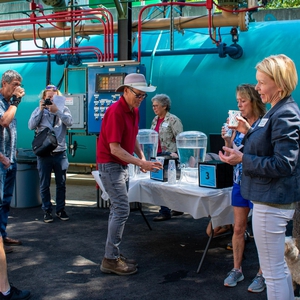
In 2022, the District completed $3.5 million in upgrades to the Orchard Run Water Treatment Plant to improve water esthetics and enhance the plant's efficiency. Read more about this Capital Improvement Project here.
Water provided by the District meets or exceeds the strict requirements of both the State Water Resources Control Board and the Federal Drinking Water Standards.
Water Quality Reports
The District is committed to transparency and providing comprehensive information about its water and operations to the community. To help with this commitment, the District produces an annual Water Quality Report that describes where water comes from, what it contains and how it compares with State and Federal Drinking Water Standards. The report contains the actual results of hundreds of water quality tests conducted throughout the year as well as other information.
- Water Quality Report 2025
- Water Quality Report 2024
- Water Quality Report 2023
- Water Quality Report 2022
- Water Quality Report 2021
- Water Quality Report 2020
Lead in Drinking Water
Lead is a naturally occurring metal that can be found in air, soil, dust, food and water. However, lead is harmful if inhaled or swallowed. To minimize exposure to lead the U.S. Environmental Protection Agency has a standard and action level for drinking water. Currently, the Action Level for lead is 15 micrograms per liter (or parts per billion). The District tests for lead quarterly in source water pumped from wells and treated water as it leaves the treatment plants and our samples are always absent of lead. Since 1993, the District has regularly tested the water at a selected number of higher-risk homes that were constructed using copper pipes with lead solder prior to the 1986 federal ban on lead solder. Monitoring is conducted in accordance with regulatory requirements and guidance.
All water systems are required to conduct an initial lead service line inventory by October 16th, 2024. The Scotts Valley Water District has completed this initial lead service line inventory required by the US EPA’s Lead and Copper Rule Revisions. The Scotts Valley Water District used a machine learning approach to developing this initial inventory, which was approved by the State Water Resource Control Board Division of Drinking Water. After investigating all applicable sources of information, the Scotts Valley Water District determined that it does not have lead service lines or galvanized requiring replacement service lines. Please see the Scotts Valley Water District No Lead Statement here.